“The tragedy of faith isn’t that it’s false — it’s that it cannot even risk being false.”
From silencing heretics to branding doubt as sin, many religions had long treated honest inquiry as a threat than a tool. When Copernicus proposed that the Earth revolves around the Sun, and Galileo dared to confirm it with evidence, the response from religious authorities wasn’t curiosity but condemnation. Their findings didn’t just challenge a cosmology; they threatened a theology. And so, rather than revising doctrine, the Church branded them heretics. Over time, some religious voices have tried to retroactively absorb scientific discoveries by saying, for example, that the Big Bang was God’s way of speaking the universe into being, or that Genesis is metaphor, not history. That is not adaptation but rather reinterpretation after retreat. It is belief bending just enough to survive, not enough to be tested.
For many of us who left religion, it was not hatred or pain that drove us out nor a mere rejection of supernatural authority on a whim. It was the simple, quiet act of asking questions and a commitment to a worldview that holds truth to the fire of evidence, testability, and doubt. At the heart of this commitment lies falsification – not just a philosophical idea, but a practice that distinguishes genuine knowledge from wishful thinking. In Conjectures and Refutations, Karl Popper sought to answer what makes science scientific and what distinguishes the sciences apart from something that just looks like science (pseudo-sciences). During his time, Popper noticed a sharp difference between the science that Einstein was practicing and what was wrong with the science that Freud was doing.
And he realized that what Einstein was doing involved risks and made clear predictions. One experiment that would prove those predictions wrong would be enough to discard his hypothesis. If reality did not conform – if light failed to bend around the sun as predicted – the theory would collapse. That’s the risk of doing real science: you put your ideas out there, and you let reality judge them.
Freud’s psychoanalysis, on the other hand, did not take such risks. No matter what happened, Freud could always twist the theory to explain it. If a patient acted one way, it was repressed trauma; if they acted the opposite, it was still repressed trauma. No matter what a patient did or said, Freud’s framework could be retrofitted to explain it. Nothing could falsify it, and that was precisely the problem.
What makes [truth] powerful is not that it’s unquestionable, but that it survives every attempt to question it.
From this, Popper established that the criterion that makes science as science is its refutability, testability, and falsifiability. In other words, to be able to say that something is true, it must be possible for us to test its truth by attempting to refute and falsify it and fail to do so. The truth of an idea will then be dependent upon the failure to falsify an idea after the most ruthless and rigorous attempts to disconfirm it. What pseudoscientific thinking does is to escape falsification by either making and even twisting ideas to make them immune to falsification, handpicking ideas that will seem to confirm it or reject the practice of experimentation. This is what we see in astrology, in conspiracy theories, and, far too often, in religion: not ideas tested by fire, but beliefs wrapped in fireproof faith. It builds theories that explain everything and risk nothing – theories too slippery to be pinned down, too vague to be broken.
Even Stephen Hawking agreed with Popper in A Brief History of Time:
“Any physical theory is always provisional… you can never prove it. No matter how many times the results of experiments agree with some theory, you can never be sure that the next time the result will not contradict the theory. On the other hand, you can disprove a theory by finding a single observation that disagrees with the predictions of the theory.” (p.11)
The truth of an idea is always, in principle, a conjecture rather than an absolute, provisional and tentative upon it being falsifiable in principle and not being falsified. Even 1+1=2 may appear as an absolute truth, its truth is grounded in the formal rules of arithmetic. But those rules themselves can be questioned, modified, or replaced in alternative systems. So in that sense, even the most basic truths are not sacred. They are conditioned by the framework we choose and, when treated as empirical claims, must still prove themselves consistent and applicable in the world. 1+1=2 is true within arithmetic but truth is never beyond question. What makes it powerful is not that it’s unquestionable, but that it survives every attempt to question it.
Likewise, if someone truly wants to know whether Santa Claus is real, the honest thing to do is not to go looking for signs that confirm the belief such as a gift under the tree, a cookie mysteriously eaten, etc. Those are easy to find when you’ve already decided what you want to see. Real belief in truth begins by trying to prove yourself wrong and failing. That’s the difference between wishing something were true and actually testing if it is. Anyone can find “evidence” for a belief if they’re only looking to be right. But truth demands the opposite: the willingness to be wrong. And if a belief can’t survive that test, it was never grounded in truth to begin with.
If God was to suddenly appear right before our own eyes, reason would require us to revise our beliefs. But recognizing a god’s existence is not the same as offering it our worship. There is a deeper question beyond “Is it real?” and that is – “Is it worthy?” A deity obsessed with constant adoration and demanding of blind obedience instead of judging people based on integrity and following conscience regardless of belief is not a moral guide, but a cosmic despot. To worship such a being is not a sign of faith, it is the surrender of dignity (which is a topic for another time).
To be clear, this is not an attempt to claim that falsification alone defines the entirety of science, nor that it holds a monopoly on the path to knowledge. The philosophy of science is far too intricate, and epistemology far too old and unsettled, for such a sweeping reduction. Instead, the purpose of this paper is to extract the lessons we can learn from the practice of falsifying – to look at what the act of trying to prove ourselves wrong can teach us about truth, about intellectual honesty and humility, and about the kind of thinking that dares to be wrong in order to be right. Because sometimes, it’s not about having the final answer, but about having the courage to ask, “What if I’m wrong?” and meaning it.
Falsification, in many ways, is the reason why we stopped believing in the first place. For some, the path away from religion began in pain, in trauma, in betrayal, in the cruelty masked as holiness. But even oppression is a kind of evidence that shows an error in a belief system that claims moral perfection handed down by the divine. In time, many of us came to do what religion fears most, the act of questioning the beliefs we were once told were sacred. And when those beliefs failed the test, when they collapsed under the weight of their own contradictions, that’s when departure from religion happens.
Disbelief, then, is not born of hatred, it is born of courage. The courage to ask difficult questions and follow evidence instead of given beliefs. And above all, the humility to change our minds when reason demands it; that is not a sign of weakness, that is wisdom. Because if we refuse to challenge our own beliefs, if we cling to them simply because they’re familiar or comfortable, we become no different from the dogmas we escaped. The point is that we should take no sides except with truth because truth matters more than any belief. That is what philosophy teaches. That is what humanism insists: follow the argument, wherever it leads, and have the integrity to go with it.
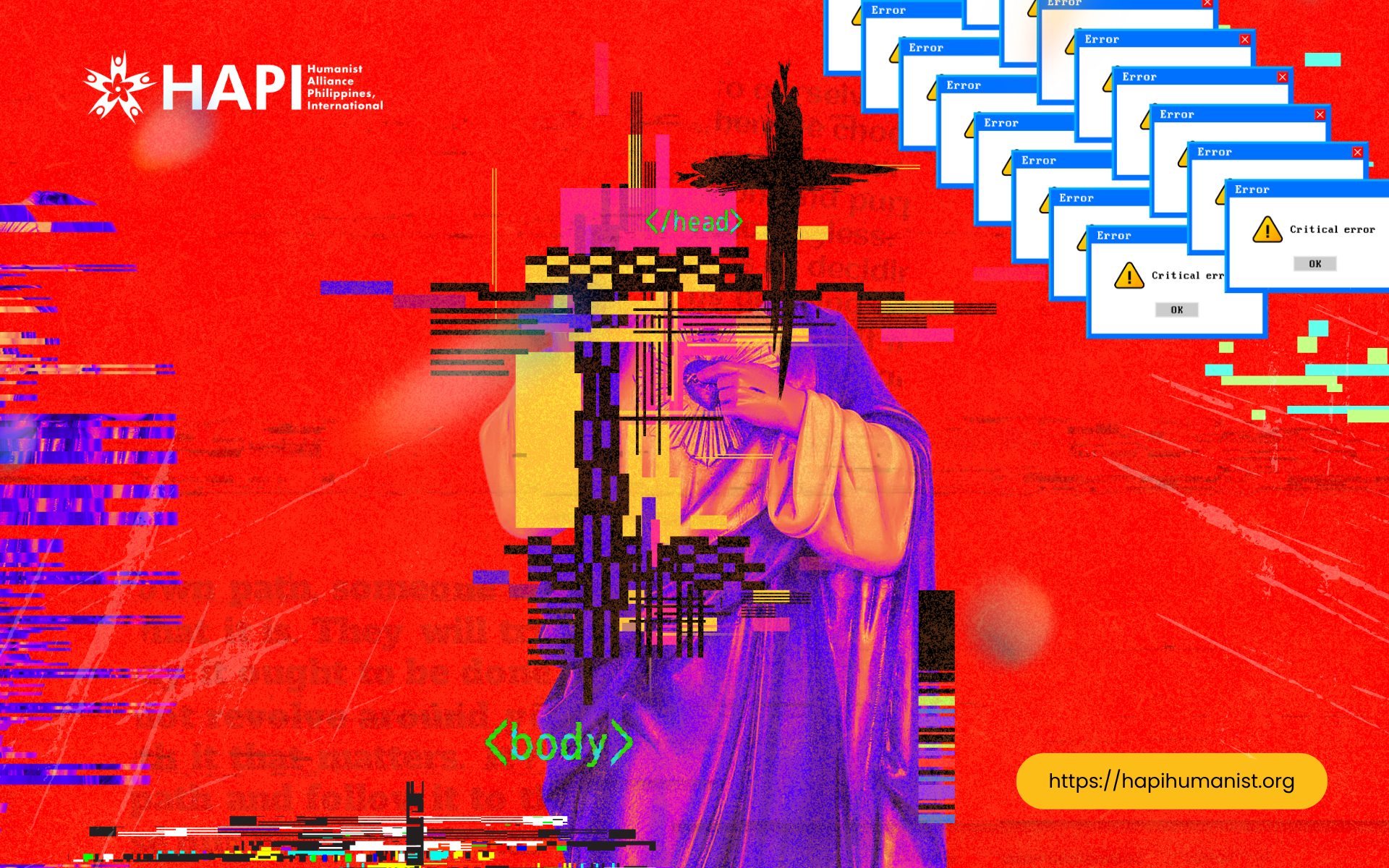
Cover art edit taken from BBC Portugal
References used in this article
- Hawking, Stephen. A Brief History of Time : From the Big Bang to Black Holes (London: Bantam Books, 1989), 11.
- Popper, Karl., Conjectures and Refutations: The Growth of Scientific Knowledge (Oxfordshire: Routledge Classics, 2002).
SUPPORT OUR MISSION
Enjoyed this article?
Give once, or become a monthly supporter — every gift helps HAPI continue its work for humanism across the Philippines.

Powered by 
Friend of HAPI
Humanist Supporter
HAPI Humanist Advocate
Humanist Champion
Cancel anytime from your PayPal account.