Reflections by Diosa Aguila-Aguirre, HAPI CFO, at Halxyon Club, Poblacion, Makati last August 4.
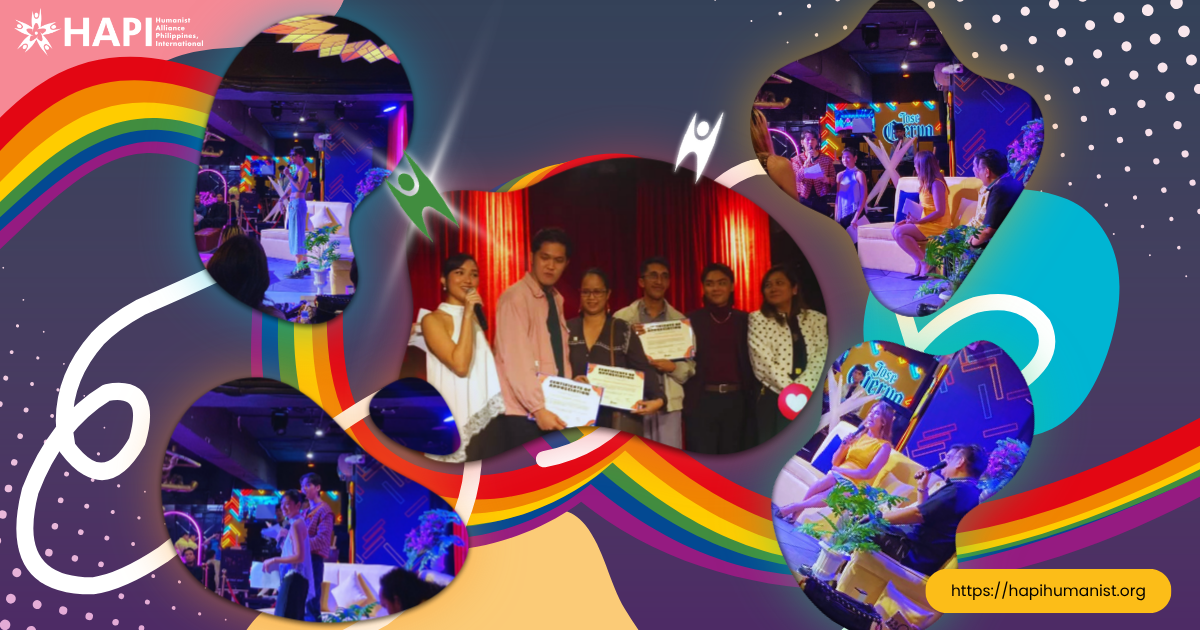
On August 4, 2026, Halxyon Club in Poblacion, Makati opened its doors for the Partners Networking Soiree, an invitation-only gathering co-presented with Pride PH. The theme for the evening was “Beyond Pride: Turning Visibility into Everyday Inclusion.”
I had a chance to attend the soiree to represent HAPI (we are a Sunshine partner of the gathering). I was eager to attend this gathering as I was unable to join the main Pride event last June.
The evening brought together corporate leaders, donors, volunteers, and change-makers, with a panel discussion moderated by Mela Habijan and insights from Angelo Camaya (Chair, PFIP Board of Trustees) and Atty. Eljay Manuel Bernardo (Executive Director, Rainbow Rights), hosted by celebrity advocates Sky Quizon and Karina Bautista.
Why This Matters to Us, as Humanists
Before getting into the recap, it’s worth naming the lens HAPI brings to a room like this.
In humanism, human dignity and human rights do not need to be earned or approved by anyone. They’re owed to people simply because they are people. Applied here, that means LGBTQIA+ rights aren’t a controversial “issue” to be debated. They’re a straightforward extension of the same ethical principle that grounds every human rights claim: that people deserve to live, work, and love without needing anyone else’s permission to be who they are.
That’s also why a night like this sits comfortably with our humanist values. Safe spaces, corporate inclusion, and legal protection for political expression are really the same idea repeated in different registers: human wellbeing, dignity, and freedom of conscience come before institutional comfort. “Beyond pride” isn’t just a slogan, but an ethical mandate to treat people well in every opportunity everywhere.
Welcome Remarks: The Club with a Mission
The soiree opened with a welcome from Halxyon Club. This new bar was built with a “deeper mission” from day one: to be a nightlife spot in Poblacion that doubles as a safe space for art, talent, and LGBTQIA+ advocacy to grow side by side.
Welcome remarks were given by Rodina Singh, Pride PH national convener and filmmaker, reflecting on how the march has grown. Pride PH had estimated a turnout of 7,000 at the Quezon City Circle during its launching; the actual number was 25,000, and it has kept growing every year since.
The note to sponsors in the room was clear and a little bit cheeky: thank you for this year, and please come back bigger next year, since the ambitions for 2027 are already larger than what this year’s budget could support. I look forward to HAPI joining again next year so we can keep showing our support for the cause.
The Panel
The panel was the cherry on top of the evening, in my opinion. Most of the topics were new to me in the realm of LGBTQIA+ talks, even though I thought I was already fairly immersed in it. Moderated by Mela Habijan, the conversation moved fluidly between representation, legal protection, corporate funding, and solidarity across marginalized groups.
What does it actually take to sustain this, inside companies and inside movements, once the visibility fades and the daily work begins?
Mela opened by congratulating the cause, pointing out that the whole nation can see equality and inclusion getting stronger year by year. That optimism set the tone, but the panel kept circling back to a harder question underneath the celebration: what does it actually take to sustain this, inside companies and inside movements, once the visibility fades and the daily work begins?
Representation came up first. Someone on the floor put it plainly: “You are visible in your own companies; that’s why the narrative of DEI continues… it’s very important to take up space.” The manifestation was specific: more bakla, tomboy, nonbinary, and intersex people rising to become CEOs of multinational companies and local organizations, positioned to “interject” the intersectional issues that affect everyone, because they’d be the ones holding decision-making power. This is a call for everyone in the room to champion the cause in their own companies, because no one will do this but us.
That led into the real question: how far can you actually take advocacy while still holding a corporate job? For example, how do you advocate for bills like the SOGIE Equality Bill or the Marriage Equality Bill without putting your job at a multinational company at risk?
Atty. Eljay Manuel Bernardo (Rainbow Rights) answered with a legal reality check: company rules are subordinate to the Philippine Constitution’s protection of free political expression. In fact, political identity and belief receive some of the highest protections under Philippine free speech law, so companies have weak legal footing if they try to discourage employees from expressing them. His practical advice for a company that oversteps: start with dialogue and “remind them first,” in his own words. Organizations like Rainbow Rights exist specifically to back employees up if a firmer reminder is needed. Grounding LGBTQIA+ advocacy in constitutional and secular civil-rights language, rather than in any one religious tradition’s approval, is precisely the kind of universal, reason-based footing humanist ethics tries to build rights on.
As someone who also works in a multinational company, this was eye-opening and good to know, especially since I’m an ally who has joined activities supporting LGBTQIA+ colleagues.
Angelo Camaya, PFIP’s Chair, took it from the corporate angle: multinational companies in the Philippines follow global DEI policies set at headquarters, but still localize them for the local context. Part of PFIP’s role has been pushing companies to cultivate strong internal “pride leaders,” since those individuals end up functioning as the actual voice of the LGBTQIA+ community inside each organization. He named the harder truth underneath the question too: it is genuinely hard right now for queer employees and other minority groups, because DEI has faced real political pushback. The ask to corporate Pride supporters is simply to keep showing up and doing their best so the deeper purpose of diversity, equity, and inclusion continues to hold at the workplace, not just on a banner in June.
Even though I’m based here in the Philippines, I’ve also felt the toning down of DEI activities in the company I work for, as well as in social media events. We still feel the effects thousands of miles away, mainly because many of the multinational companies here are US-based. That’s why I agree with the panel that we need strong and resilient leaders who won’t back down and will fight for projects that amplify the voices of the marginalized. For me, that also implies we need to support our leaders, because they can only stay strong if there are many people behind them fighting for them too.
PFIP, Camaya’s own organization, started in 2013 with just five member companies. Now, there’s over 100 of them. Growth wasn’t a straight line, though. Political shifts abroad last year pushed some multinationals to pull back on DEI, not just LGBTQIA+ programs. PFIP’s response was to get creative, leaning into intersectionality instead of running LGBTQIA+ initiatives alone. And while the U.S. picture looks uncertain, Camaya pointed to Asia instead: marriage equality moving in Thailand and Taiwan, a push in Japan, Singapore repealing its anti-gay law, and new gender recognition bills popping up regionally. His point being that the Western pushback narrative is real, but it’s not the whole story. Asia is where a lot of the momentum actually is right now.
With this, advocates can leverage this Asian momentum to push for many rights, including LGBT rights. If those countries can do it, it’s high time we did too.
[H]umanists, especially those identifying as ‘nones’ (having no religion), belong to this fight too, here in the Philippines.
Mela widened the circle around this point too, acknowledging that this movement encompasses all marginalized communities: PWDs, the aging, indigenous peoples, everyone has a stake in this struggle. I’d say we as humanists, especially those identifying as ‘nones’ (just 0.04% recorded as having no religion in latest official PSA census statistics), belong to this fight too, here in the Philippines. Our right to live peacefully within our own communities, without being judged or disowned just because we have a different religion, or none at all, is what resonated with me most.
Another topic worth noting from the panel was the broader point about money: movements like this can’t keep leaning indefinitely on foreign grants and industry donors, and sustainability has to be built in.
That landed hard for me personally. This resonated with me for our own humanist movement too, as HAPI is still rebuilding. Hearing this panel say it out loud about their own movement was an alarm, a reminder for me to explore ideas ASAP.
Funding kept surfacing, in fact, as its own quiet thread throughout the panel, not just as a movement-level problem but as a company-level one. It was highlighted that it’s important now to have LGBTQIA+ leaders inside companies who fully support the cause, and that this isn’t pinkwashing but a real way to support employees and make them feel represented. On the finance side, getting funding for orgs like this from inside a company isn’t easy; it takes months, sometimes years, of planning. July is apparently when talks with pride leaders start, since budgets need to be submitted, which is exactly why having strong pride leaders matters so much. Thanks to them for fighting for that budget every year. We need to celebrate all of it.
“This is only the beginning”
The program closed with a note of gratitude to Pride PH, sponsors, performers, and everyone who “believed in this vision,” reaffirming a commitment to being a safe and empowering space. HAPI received its certificate of participation alongside the other partners in the room.
The closing line doubled as a save-the-date: see you in 2027 Pride.
Walking away from a room like this, I don’t think HAPI needs a new value to bring to the table. Dignity that isn’t conditional was already in the room all evening. That’s what “everyday inclusion” really means: it has to hold up on ordinary days, under ordinary pressure, not just when the occasion calls for it. I believe HAPI can always go the extra mile in supporting Pride PH. It may not be monetary,because it’s limited right now, but we can give them thunderous cheers of support, year after year.
References
Amnesty International. (2019, May). Taiwan: Same-sex marriage law enters into force [Press release]. https://www.amnesty.org/en/latest/press-release/2019/05/taiwan-same-sex-marriage-law/
Bulatlat. (2025, June 24). After 25 years, SOGIESC Bill still awaits passage. https://www.bulatlat.com/2025/06/24/after-25-years-sogiesc-bill-still-awaits-passage/
Congress of the Philippines. (2026, March 11). Primary referral: House Bill No. 8420 [Legislative tracker]. https://www.congress.gov.ph/committees/view/primary-referal/?code=A504
The Japan Times. (2025, November 28). Same-sex marriage ban constitutional, says Tokyo High Court. https://www.japantimes.co.jp/news/2025/11/28/japan/crime-legal/same-sex-marriage-ruling-tokyo-constitutional/
Ministry of Home Affairs, Singapore. (2022). First reading of the Penal Code (Amendment) Bill and the Constitution of the Republic of Singapore (Amendment) Bill [Press release]. https://www.mha.gov.sg/media-room/newsroom/first-reading-of-the-penal-code-amendment-bill-and-the-constitution-of-the-republic-of-singapore-bill/
Philippine Financial and Inter-Industry Pride. (n.d.). Our story. PFIP. https://pfip.com.ph/our-story/
Rainbow Rights Philippines. (n.d.). Home. https://rrightsphl.org/
Reuters. (2025, January 23). Factbox: Thailand’s same-sex marriage law. U.S. News & World Report. https://www.usnews.com/news/world/articles/2025-01-23/factbox-thailands-same-sex-marriage-law
SUPPORT OUR MISSION
Enjoyed this article?
Give once, or become a monthly supporter — every gift helps HAPI continue its work for humanism across the Philippines.

Powered by 
Friend of HAPI
Humanist Supporter
HAPI Humanist Advocate
Humanist Champion
Cancel anytime from your PayPal account.