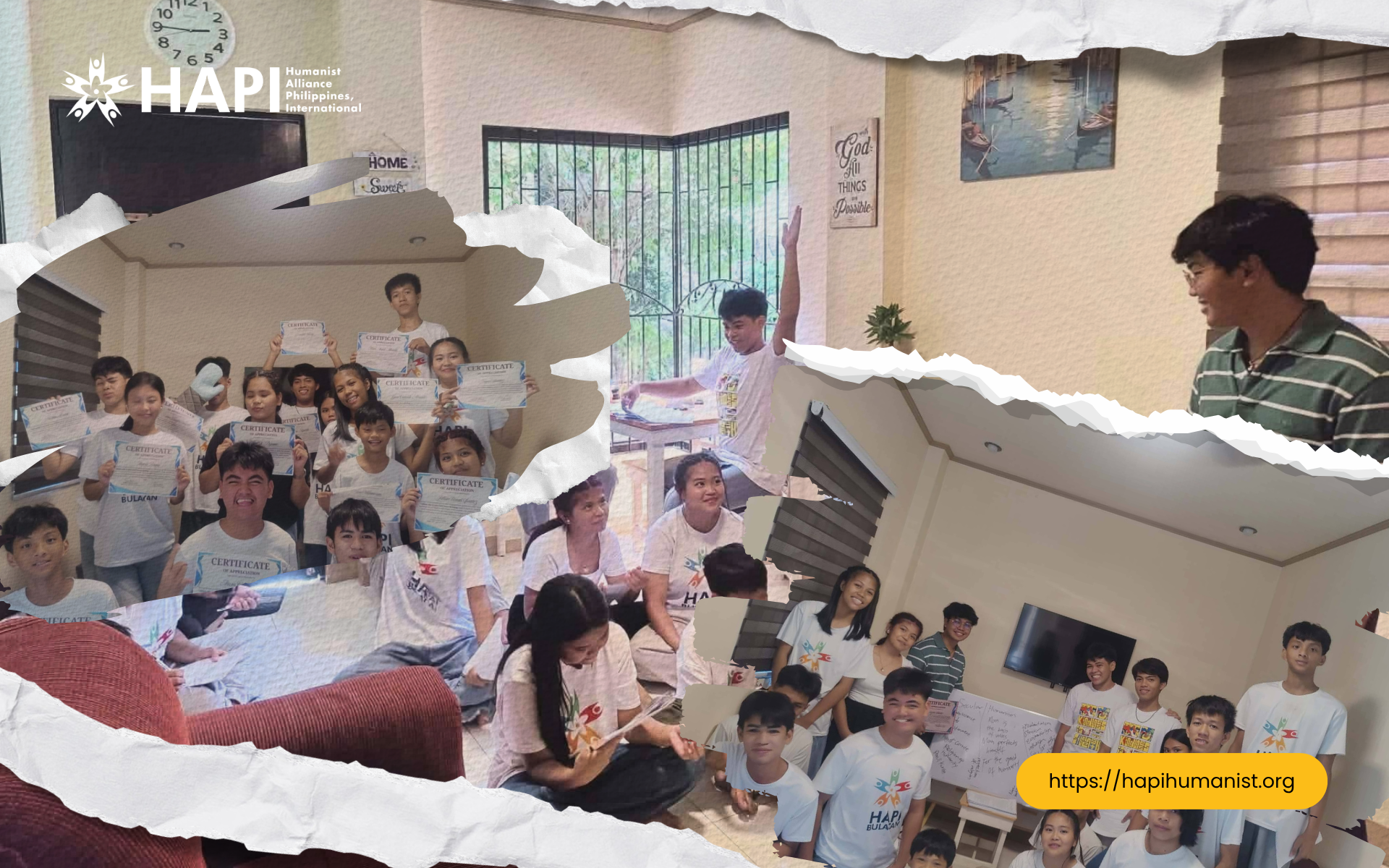
Last April 22, 2026, the youths of HAPI Bulacan participated in a seminar-lecture with the theme “Lakbay Isip at Laro:” HAPI Team Building. The event was made possible through the support of Humanist Mutual Aid Network and Hank Pelliser, the main sponsor. Organized by Anne Christine Valenzuela and executed by HAPIsko Irine Dipano, the team building took place at Nature Care Transient House in Malolos, Bulacan where the youth of HAPI Bulacan gathered to learn deeper about secular humanism.


The lecture was led by guest speaker and HAPIsko, Mark Jaztine P. Santos, whose discussions dealt with the philosophical foundations, history, and in-depth background of secular humanism. He began by discussing how secular humanism is a life stance and a philosophy that evolved from syncretism and a long chain of ideas that developed and were influenced by various schools of thought throughout history. It would be easy to say and define what secular humanism is but without grounding what is necessary to understand it, one must build an adequate and strong philosophical background in order to fully appreciate it. To this end, the lecturer began by building an understanding of what philosophy is and what it does. Then, he proceeded with discussing the philosophical influences that shaped secular humanism such as William Clifford’s evidentialism, falsificationism, and logical soundness which form the basis of critical thinking.
It was then followed by a short discussion on secular value theory, particularly on ethics, and philosophy of religion. It began by challenging the divine command theory as the basis of morality through the Euthyphro dilemma accompanied by a discussion on Bertrand Russell’s Problem of Hell and Epicurus’ Problem of Evil. Consequently, as an alternative to faith-based morality, the lecturer discussed how morality could exist outside of religion. He highlighted ethical pluralism, which teaches that an action can be right either by itself or by duty to a higher moral law. One does not need religion to determine what’s right from wrong because morality exists precisely because other people exist. What one lacks by not being able to determine right from wrong is empathy, not religion.
After the lecture on ethics, a short discussion on Jean Paul Sartre’s existentialism and Albert Camus’ absurdism enlightened the youths that the meaning of life does not inherently exist. Discussing these influences are necessary so one must know how to think and empathize as a secular humanist. Then, for the final part, the history of secular humanism was discussed; it emphasized Paul Kurtz’s writings on eupraxophy – an umbrella term for all ideas that are secular and humanistic by nature such as existentialism, evidentialist, etc. Kurtz also argued for eupraxsotheques – meaning, places for eupraxophy – which are institutions or organizations that are aimed at executing secular humanism as an advocacy and as a movement. This idea then led to all the existing secular humanist organizations that are actively involved in advancing secularism as a movement against religion and the unconditional execution of ethics and extension of compassion for the benefit of humanity as a whole. Humanist Alliance Philippines, International (HAPI) is one of such eupraxsotheques that stays true to this goal of shaping evidence-based, ethically compassionate critical thinkers and making the world a better place without appeal to supernatural beliefs or religious dogmas.


The event was an opportunity for Bulacan youth to bond and form meaningful connections with one another. The lecture lasted for 3 hours and its purpose was to deepen the youths’ understanding and appreciation of secular humanism. After the lecture, they vocally demanded evidence before belief and assessed their moral compass before action. Surely, they brought with them the lessons they have gained and a way of thinking that defies gullibility. Afterwards, they had a meeting regarding future events – and on a lighter note, played tug of war and a quiz bee on general knowledge that helped create lasting memories.
SUPPORT OUR MISSION
Enjoyed this article?
Give once, or become a monthly supporter — every gift helps HAPI continue its work for humanism across the Philippines.

Powered by 
Friend of HAPI
Humanist Supporter
HAPI Humanist Advocate
Humanist Champion
Cancel anytime from your PayPal account.